You have three hours a week for marketing and a blog that hasn't cracked page two of Google in eight months. That's the actual starting point for most indie SaaS founders, and it's why the wrong AI SEO tool costs you more than money — it costs you the three hours you didn't have to spend.
The right AI SEO tools for indie SaaS founders do three things: find keywords you can realistically rank for, tell you exactly what to write, and get it published without a content team. Everything else in this category — the dashboards, the "AI-powered" scoring widgets, the 40-tab suites built for agencies managing twelve clients — is overhead you're paying for and not using.
Most of what's marketed as an AI SEO tool was built for a different buyer. Agencies need client reporting, white-label exports, and seat management for a team of six. You need one thing to happen every week: a piece of content that targets a keyword you can actually win, published somewhere real. That mismatch is why so many solo founders try Semrush or Ahrefs, use 8% of the features, and quietly cancel three months in.
What should an indie SaaS founder actually look for in an AI SEO tool?
An indie SaaS founder should prioritize tools that filter for winnable keywords — not just high-volume ones — and that shorten the distance between "found a keyword" and "published a page." The best fit combines keyword difficulty filtering, brief or draft generation, and direct publishing, because a solo founder has no time to hand off work between five separate tools.
That's a narrower list than the marketing suggests. Here's how the main categories stack up when you're the only person on the team:
| Tool type | Best for | Time cost per week | Team size assumed |
|---|---|---|---|
| Enterprise SEO suites (Semrush, Ahrefs-style) | Agencies managing multiple clients | 3-5 hours to extract useful data | 3+ people |
| AI content generators only | Fast drafting, no strategy | 1-2 hours writing prompts, more editing | 1+ people, but still needs a strategist |
| Rank trackers / GSC-only setups | Founders who already know their keywords | 30 min, but no discovery | 1 person |
| Gap-analysis + auto-publish tools (like WriteGap) | Founders who need discovery, drafting, and publishing in one motion | Under 30 minutes to review and approve | 1 person |
The pattern: every extra tool in your stack adds a handoff. A handoff is where solo founders lose momentum, because there's no second person to pick up the task when you get busy shipping product instead.
The free stack you should run before paying for anything
Before you spend a dollar, three tools cover the baseline every paid product builds on top of. Google Search Console tells you which queries you already show up for, your average position, and your click-through rate — if you're not checking this weekly, no AI layer on top will fix the gap. Google Analytics 4 connects that traffic to actual signups, because ranking without conversion is a vanity metric dressed up as a KPI. And a basic keyword-volume browser extension gives you rough demand data for a few dollars, which is enough to sanity-check ideas before you commit a week to writing them.
This stack won't get you past your first few hundred organic visits a month. It has no opinion on what to write next, no way to spot which keywords you can actually win, and zero automation. That's fine, it's not supposed to replace strategy. It's supposed to be the floor everything else stands on. If you want the fuller breakdown of running this manually before you have budget, the keyword gap analysis for indie SaaS founders with no budget guide covers it in detail.
Where AI actually earns its keep in SEO right now
AI is genuinely useful in three specific spots, and genuinely overhyped in a fourth.
It's useful for keyword gap analysis, comparing your site against competitors and surfacing terms they rank for that you don't, then scoring which ones you could realistically win given your domain's current authority. It's useful for brief generation, turning a raw keyword into a structured outline with the subtopics competitors cover, so you're not staring at a blank doc. And it's useful for first-draft generation, provided you treat the output as a draft and not a finished article.
Where it's overhyped: fully autonomous "set it and forget it" publishing with zero human review. Anyone selling that as the pitch is selling you thin content that Google will eventually discount, and your readers will bounce off immediately. The founders who get real traffic from AI-assisted content are the ones who still spend 10-15 minutes reviewing each draft before it goes live, checking the examples are real, the numbers are accurate, and the voice sounds like a person who actually uses the product.
This is the part most guides on this topic skip entirely: they'll tell you AI content generation exists, but not how to keep it from reading like it. A contractor doesn't start building from a verbal description, they get a plan. Same logic applies here. A good brief, built from real competitor gaps, is what keeps AI-generated drafts from sounding generic. Skip the brief and you get generic filler that ranks for a week and drops. WriteGap builds that brief automatically from the keyword gap it finds, then generates the draft against it, so the AI is writing to a spec, not guessing.
The gap nobody talks about: SEO tools built for teams, sold to solo founders
Here's the part of this category that gets glossed over. Most AI SEO tools, including plenty marketed at "startups", were architected around agency workflows: multiple client accounts, team permissions, white-label reports, approval chains. Indie founders buy them anyway because there's no clearly labeled alternative, then spend the first month just figuring out which 10% of the dashboard applies to a team of one.
That mismatch shows up in three concrete ways. First, pricing tiers assume you'll want to add seats, you won't, because there's no one to add. Second, the reporting features assume you need to justify spend to a client or a boss, you don't, you just need to know if it's working. Third, and most costly: the workflow assumes a division of labor between a strategist who picks keywords, a writer who drafts content, and an editor who publishes it. You're all three people, and the tool doesn't know that.
A tool built specifically for solo founders and two-person teams collapses that chain. It picks the keyword, builds the brief, drafts the content, and pushes it live, with one review step, not four. That's the actual gap in this market: not a lack of AI, but a lack of tools that assume the buyer is one person with limited hours, not a department. If you're evaluating tools with this specific constraint in mind, the breakdown at SEO for indie hackers goes deeper on what that means in practice.
What "winnable keyword" actually means, and why it matters more than volume
A winnable keyword is one where your domain's current authority is close enough to the ranking pages that you can realistically break into the top ten within a few months, not the highest-volume term in your niche, which is usually locked up by sites with ten times your backlink profile.
Winnability beats volume every time. A keyword with 200 monthly searches that you can rank for in 60 days beats one with 5,000 searches that requires domain authority you won't have for two years. Most keyword tools sort by volume by default, which is exactly backwards for a site with limited authority. What you want is a tool that filters for the intersection: real search demand, plus a difficulty score realistic for where your site sits today. That's the whole premise behind gap analysis, finding what competitors with similar-sized sites already rank for, on the theory that if they cracked it, you probably can too.
Common mistakes that waste the AI SEO budget you do have
A few patterns show up again and again with solo founders who try this category and quit:
- Buying an all-in-one suite for its keyword database, then never using the content or publishing features it also charges for.
- Generating AI drafts with no brief, producing generic articles that rank briefly and then get outranked by more specific competitor content.
- Chasing high-volume head terms instead of the long-tail queries your actual authority can support, see the long-tail keywords for SaaS breakdown for why this trips up smaller sites specifically.
- Ignoring Google Search Console data after setup, missing keyword cannibalization where two of your own pages compete for the same query and split your ranking potential.
- Publishing without checking for internal duplication across old content, which quietly caps how well new pages can perform.
Connecting Google Search Console isn't optional busywork here, it's the feedback loop that tells you whether the keywords you targeted are actually converting into impressions and clicks, and it's how cannibalization gets caught before it costs you months of flat rankings. WriteGap uses that connection to flag competing pages and suggest fixes automatically, instead of leaving you to spot the pattern manually across a spreadsheet export.
How much does this actually cost a solo founder to run well?
Running AI SEO well as a solo founder costs less in tools than it costs in your own hours if you do it manually. A single simplified tool covering gap analysis, brief generation, and publishing typically runs a fraction of what a freelance SEO writer charges per article, and it doesn't require managing a contractor relationship on top of everything else you're running.
The real cost comparison isn't tool A versus tool B. It's tool versus your own time, at whatever your time is actually worth per hour when you could be shipping product instead. A founder spending four hours a week manually researching keywords, writing briefs, and drafting content is spending roughly 200 hours a year on a task that a focused tool compresses to under 30 minutes of review time weekly, call it 25 hours annually. That's not a marginal efficiency gain. That's the difference between having a content engine and not having one.
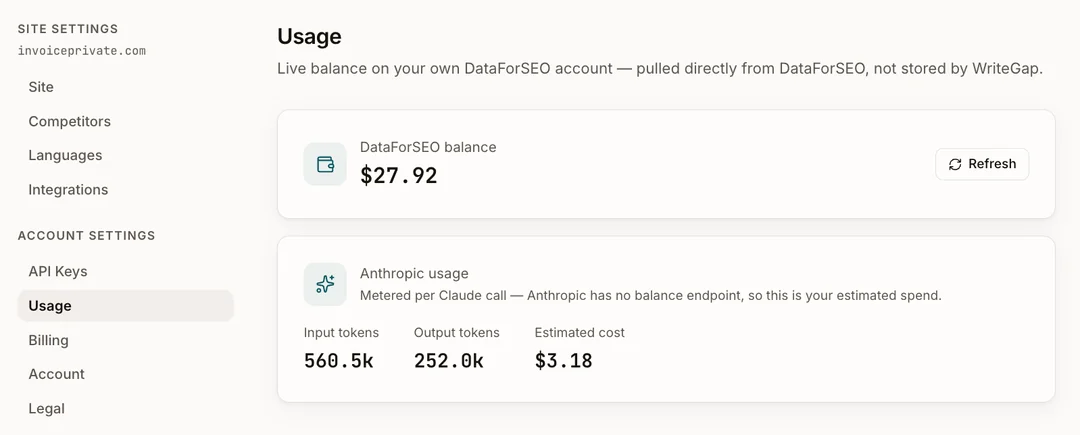
Actual numbers from a live account: a few dollars of DataForSEO balance and around $3 of Claude usage cover a real run — not a marketing estimate, the literal bill.
So which AI SEO tool should an indie SaaS founder actually pick?
Pick a tool that does exactly three things well: finds keywords you can win against your actual competitors, builds a real brief instead of a vague topic, and publishes the draft to your site without you copy-pasting between four tabs. Anything beyond that is a feature you're paying for and won't use as a team of one.
Connect Google Search Console to whatever tool you choose first, it's the one data source that tells you the truth about what's working, and it's what catches cannibalization before it quietly caps your growth. WriteGap runs on exactly that loop: it pulls your GSC data, finds the keyword gaps your competitors are winning that you're not, and generates a ready-to-publish draft for WordPress or Shopify each week, so the only decision left for you is whether to hit approve.