SEO doesn't fail founders because it's hard. It fails because it's inconsistent. You do a burst of it, get busy, drop it for two months, and the momentum dies. The founders who win at SEO aren't doing more — they're doing a small amount every week without stopping.
Here's a 30-minute weekly routine that covers the few things that actually move rankings and deliberately skips the busywork that doesn't. Do it every week and it compounds. That's the whole trick.
Why 30 minutes, and why weekly
Rankings shift weekly. New competitors appear, pages drop, Google reshuffles, your own content ages. A quarterly SEO "audit" misses all of it. A short weekly touch keeps you responding to what's actually happening while it's still fresh.
Thirty minutes is the point where the routine survives a busy week. An hour gets skipped when you're slammed; thirty minutes doesn't. Consistency beats intensity every time in SEO, because the algorithm rewards sustained signals, not sprints.
The routine
Set a recurring 30-minute block — Monday morning works well, before the week eats your calendar. Here's how to spend it.
Minutes 1–8: Check your quick wins
Open Google Search Console → Performance → filter to Position 11–20, sort by Impressions descending. These are your page 2 quick wins — keywords one good fix away from page 1, already earning impressions.
Pick the single highest-impression one. Open the page it's on and make one fix: tighten the H1 to match the keyword, add the missing section the top-3 results all have, or write a clean 40–60 word answer near the top. One fix, one page, per week. Re-submit the URL for indexing. Done.
That's the highest-return eight minutes in SEO — you're nudging something already in motion, not starting from zero.
Minutes 9–16: Scan for a new gap
Look at what your competitors are ranking for that you aren't. If you do this manually, pull one competitor's top keywords and diff against your GSC list (the method in how to find keyword gaps). If you've automated it, just read this week's surfaced gaps.
You're not writing anything yet. You're picking one gap that passes the filters — reasonable volume, winnable difficulty, genuine intent, and adding it to your queue. One candidate a week is 50 well-chosen targets a year, which is far more than a solo founder can even write.
Minutes 17–27: Move one piece of content forward
You always have exactly one article in flight. Spend these ten minutes advancing it by one stage:
- Week A: write the brief for the gap you queued (target keyword, intent, the sections the top results cover, your unique angle).
- Week B: draft it, or edit the AI draft you generated.
- Week C: publish it, add schema, and do the 20-minute internal-linking pass (links in from existing pages, links out to relevant ones).
One article moves one stage each week. That's a published, well-structured, internally-linked article roughly every three weeks — a sustainable pace that most founders never hit because they try to write a whole article in one sitting and burn out.
Minutes 28–30: Log and glance at the trend
Note what you did in a simple log (which page you fixed, which gap you queued, what stage your article is at). Then glance at your GSC impressions trend and, if you've set it up, your AI-search traffic. You're not analyzing, just confirming the line is going up over months. Close the tab.
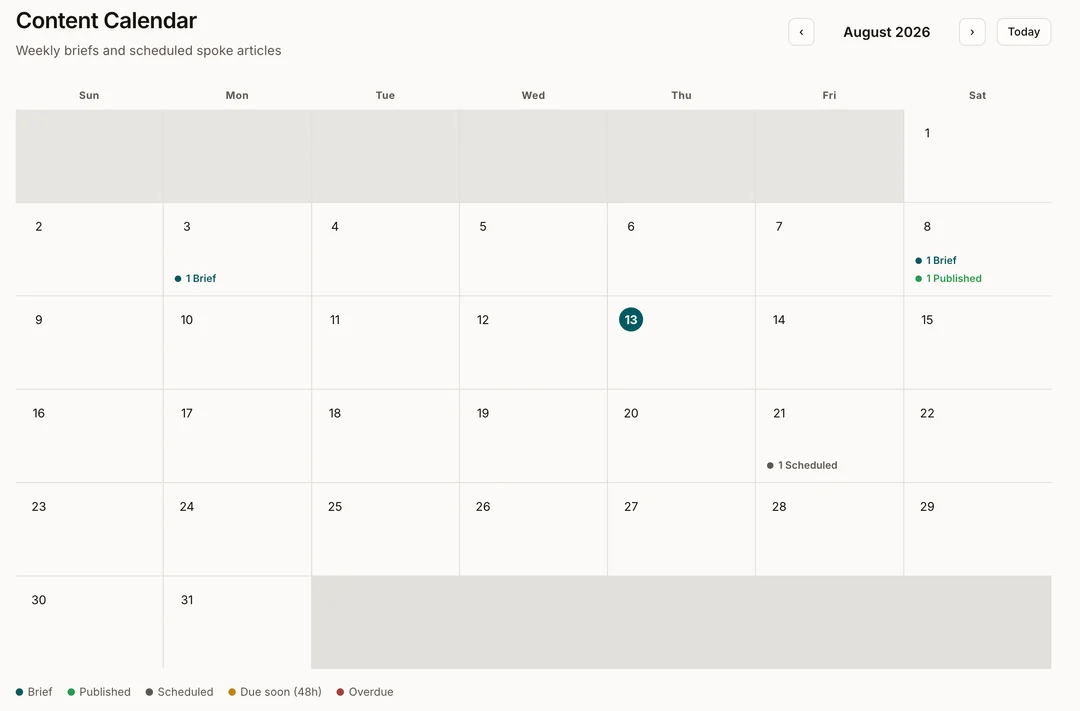
This is what "one article in flight" looks like laid out over a month — a brief, a publish, a scheduled draft, not a backlog of ten half-started pieces.
What's deliberately NOT in the routine
The routine works because of what it leaves out. These do not belong in your weekly 30 minutes:
- Chasing new backlinks. Link building is real but it's not a weekly-30-minute task, and it does nothing if your on-page is weak. Fix on-page first.
- Technical audits. Run a technical check when a specific page won't move, not on a schedule. Weekly technical auditing is mostly anxiety, not progress.
- Rewriting for AI/GEO. GEO is mostly the same fundamentals; the routine already produces extractable, ranked content. No separate AI ritual needed.
- Reading SEO news. Interesting, not urgent. It doesn't move your rankings this week.
If it's not a quick win, a gap, or moving your one article forward, it's not in the 30 minutes.
Why this compounds
Run this for a year and the numbers are quietly large: ~50 quick-win fixes, ~50 gaps evaluated, and ~15 published, internally-linked articles — each one feeding the next through internal links and growing topical authority. None of it required a heroic week. It required not stopping.
The founders who "don't have time for SEO" usually don't have a time problem, they have a consistency problem. Thirty minutes, same slot, every week, on the three things that matter. That's the routine.
Making it even smaller
The two most time-consuming parts above are finding the gap (minutes 9–16) and starting the draft (part of 17–27). Those are exactly the parts worth automating: WriteGap runs the gap analysis and generates the brief and draft for you every Monday, which collapses the routine to review the surfaced gap, make one quick-win fix, edit the draft. But the routine works with or without it, the discipline is the point, and the tools just shrink the minutes.