Pulling your competitor's keyword list and targeting everything on it is the most common keyword research mistake in SaaS SEO. You'll end up writing about topics that don't convert, competing on keywords you can't win, and burning months on content that brings zero signups.
The right approach is more selective. Here's how to analyze competitor keywords and extract the fraction that's actually worth targeting.
Step 1: Pick real competitors, not content sites
The biggest mistake before you even pull a keyword: using the wrong competitors.
Your SEO competitors aren't necessarily your product competitors. If you build a time tracking tool for freelancers, your SEO competitors might include:
- Direct competitors: Harvest, Toggl, Clockify
- Indirect product competitors: FreshBooks (because they target the same freelancer)
- Content sites: a productivity blog that ranks for "time tracking tips"
You want direct and indirect product competitors. Not content sites, not software review aggregators like G2 or Capterra, not industry blogs. Those sites rank for educational keywords that your audience will Google but won't convert from, because the person searching "best time tracking practices" isn't in buying mode.
If a site's primary business is content rather than a product that competes with yours, exclude it from your competitor keyword research.
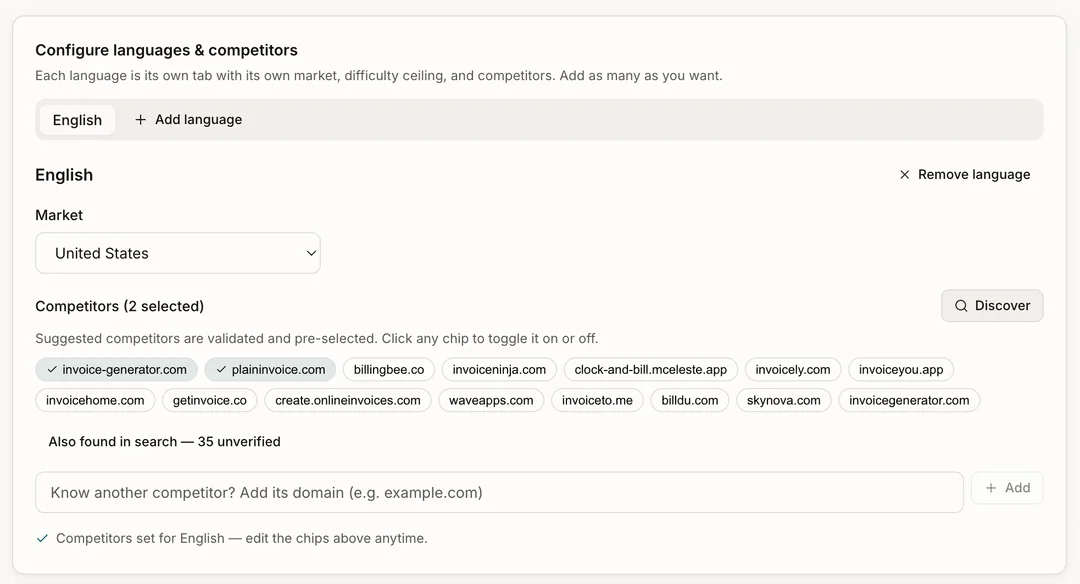
On invoicePrivate, discovery turned up 35 unverified candidates before validation — most weren't real product competitors. Only 2 survived the filter above.
Step 2: Pull their top 300 keywords, and look at the distribution
Don't just export the highest-volume keywords. Look at the full distribution of the top 300 sorted by estimated traffic.
Most SaaS companies rank for three types of keywords:
- Branded keywords: their own product name, their feature names. Useless to you.
- Feature keywords: specific capabilities — "client billing software," "automatic time rounding." High intent, often realistic to target.
- Problem-first keywords: "how to track billable hours," "freelance invoice late payment." Informational, but these searchers are your future customers.
The feature keywords and problem-first keywords are your targets. Branded keywords and navigational queries (competitor + "pricing," competitor + "review") almost never convert for you.
Step 3: Filter by the three signals that matter
After removing branded and navigational terms, filter the remaining list:
Volume: 200+ per month (for English). This isn't about the traffic you'd get at #1 — it's a proxy for whether enough people care about this topic at all. Below 200, you might rank #1 and get 15 visitors a month.
Difficulty: Under 70. Above that, you need established domain authority and a serious content operation to compete. For most indie SaaS founders, the realistic sweet spot for new articles is around 50 difficulty. Under 40 is where the real opportunity is. (More on how to read the score in our guide to keyword difficulty.)
Intent match: For each remaining keyword, ask: if someone clicks this result and my product solves their problem, would they potentially sign up? If yes, keep it. If the keyword is purely educational — "what is a time tracker", and the searcher is unlikely to be in any kind of buying mode, skip it.
Step 4: Find the gap, not just the keyword
At this point you have a filtered list of competitor keywords. Now cross-reference it with your own GSC data.
Export your top 500 keywords from Search Console. Any competitor keyword not in your list is a gap — you're not ranking for it at all. Any competitor keyword where you rank below position 20 is a potential quick win if the competitor has proven there's traffic there. (Our full walkthrough on finding keyword gaps covers the diffing step in detail.)
The gaps to prioritize: keywords where 2+ competitors rank in the top 10, and you're either not ranking or ranking below 20. Those keywords have market validation, the search demand is real and the intent is proven, and you have clear upside.
Step 5: Group gaps by topic cluster
Don't treat each keyword as an isolated target. Group related keywords into clusters:
A cluster around "freelance invoicing" might include:
- "invoice generator for freelancers" (main target)
- "how to send an invoice as a freelancer" (supporting)
- "freelance invoice template" (supporting)
- "late payment invoice freelancer" (supporting)
Write one strong pillar article targeting the main keyword, then write shorter supporting articles targeting the long-tail terms. Internal link from the supporting articles to the pillar. This tells Google your site has depth on this topic, not just one article that mentions the keyword. (This is the topic cluster model, and it's how small sites punch above their weight.)
Clusters typically outperform isolated articles because Google sees topical authority, not just individual pages.
The mistake that makes competitor research useless
The most common outcome of competitor keyword research: a spreadsheet of 500 keywords, no prioritization, and paralysis.
The fix: pick the top 3 gaps that pass all four filters (volume, difficulty, intent, multi-competitor validation), and write those articles first. Three focused, well-structured articles on proven gaps will outperform a content calendar of 20 undifferentiated articles on semi-related topics.
Competitor keyword research works because your competitors have already validated what searchers want. Your job isn't to copy their strategy — it's to identify the specific keywords where their presence proves demand exists, and where your product has a genuine answer to the searcher's question.
Filter ruthlessly. Write specifically. Track weekly.