Most SaaS blogs are a graveyard of isolated articles. One post about pricing strategy. One about onboarding. One about customer churn. No relationship between them, no internal link structure, no topical signal for Google. The result: a lot of content, almost none of it ranking.
Topic clusters fix this. The idea is simple: instead of writing 20 articles on 20 unrelated topics, you write 1 pillar article on a broad topic and 6–8 supporting articles on specific subtopics — all internally linked. The result is that Google sees topical authority, not just isolated content.
Here's how to build one that actually works.
The cluster architecture
A topic cluster has two components:
The hub (pillar article): A comprehensive, 2,000+ word article targeting a broad keyword with high volume. It covers the full topic at depth, not surface-level. This article's job is to be the best single resource on this topic. It doesn't try to rank for everything; it tries to be definitive on the main question.
The spokes (supporting articles): 6–10 shorter articles (700–1,200 words) targeting specific long-tail subtopics. Each spoke goes deeper on one aspect of the pillar topic. Each spoke links back to the pillar, and the pillar links to each spoke.
Example cluster for an invoicing tool:
- Hub: "Invoice Generator for Freelancers: Complete Guide" (targets "invoice generator freelancers")
- Spoke 1: "How to Write a Freelance Invoice That Gets Paid Fast" (targets "freelance invoice template")
- Spoke 2: "Late Payment Invoice: What to Include and When to Send It" (targets "late payment invoice")
- Spoke 3: "Freelance Invoice vs. Receipt: What's the Difference?" (targets "invoice vs receipt")
- Spoke 4: "How to Add Tax to a Freelance Invoice" (targets "freelance invoice with tax")
- Spoke 5: "Best Invoice Payment Terms for Freelancers" (targets "invoice payment terms")
- Spoke 6: "How to Invoice an International Client" (targets "invoice international client")
Every spoke links to the hub. The hub links to every spoke. This creates a topical web Google can crawl and understand.
Why clusters outrank isolated articles
Google's ranking algorithm rewards topical depth. A single well-written article about invoicing tells Google you've covered this topic once. A cluster of 8 articles — all internally linked, all covering different facets of the same topic — tells Google your site is an authoritative resource on this subject.
The practical effect: your hub article typically ranks faster than an isolated article on the same keyword would. Because Google has seen 8 pages on your site covering related subtopics, it has more evidence that your domain understands the topic deeply.
This is why large media sites dominate informational keywords, not because they have more backlinks on every individual article, but because they have hundreds of articles on each topic, and Google treats their domain as authoritative for the whole subject.
Small SaaS companies can replicate this at a smaller scale. You don't need 200 articles on invoicing. You need 8 well-targeted ones, structured correctly.
How to choose your cluster topic
Pick a topic where:
Your target customers are searching for it, not just anyone. A time tracking tool building a cluster around "productivity tips" will get traffic that never converts. A cluster around "time tracking for freelancers" will bring people actively looking for a product like yours. (Competitor keyword research is a fast way to find topics your audience already searches for.)
The hub keyword has 1,000+ monthly searches — you need enough volume for the pillar to be worth the investment. Spoke keywords can be as low as 200/month.
The difficulty is realistic — hub keyword difficulty under 60. Spoke keyword difficulty under 45.
Your competitors haven't fully covered it — if 3 competitors have full clusters on this topic with 20+ articles each, entering that space is an uphill fight. Look for topics where competitors have 1–2 isolated articles but no coherent cluster.
Building the cluster in the right order
Most founders write the hub first, then never write the spokes. That's backwards.
Write the spokes first, publish them, then write the hub.
Here's why: the hub links to the spokes. If the spokes don't exist yet, the hub is full of internal links going nowhere — either missing or pointing to placeholder pages. That's a poor user experience and a weak link structure.
Write and publish 4–6 spokes over 2–3 weeks. Then write the hub, linking to the published spokes. When the hub goes live, it immediately has a full internal link structure and each spoke has a new inbound link from the (now more authoritative) pillar.
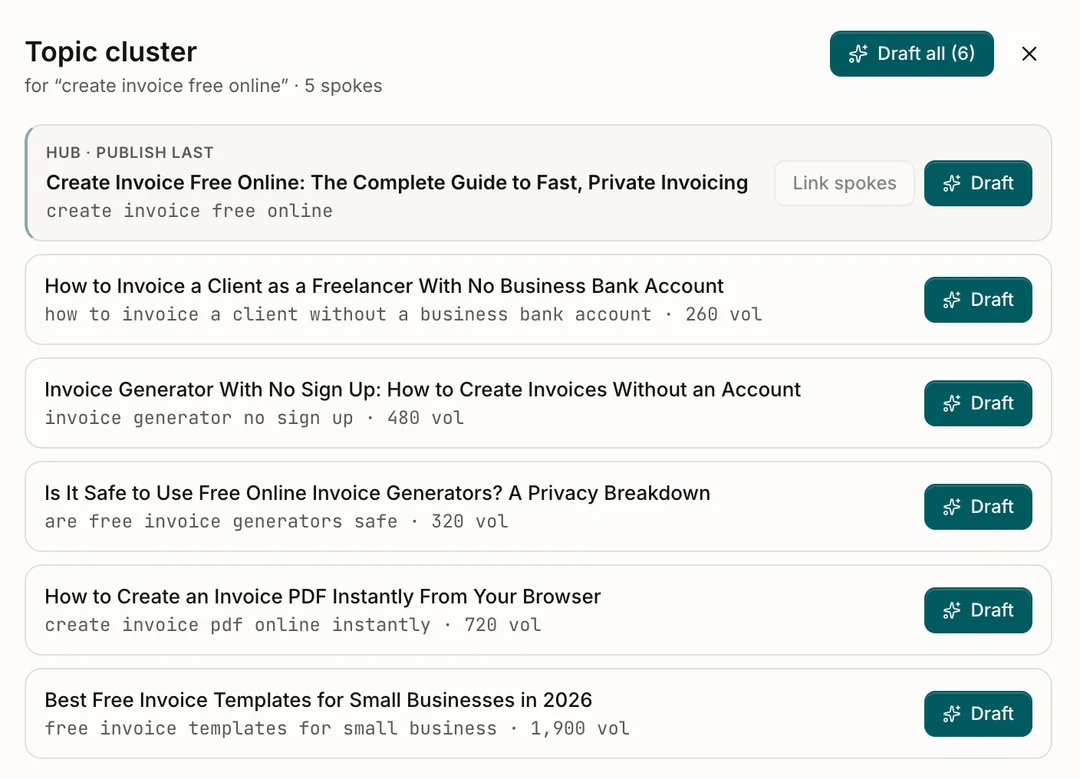
This is the exact structure WriteGap builds from a single seed keyword — one hub flagged to publish last, spokes queued above it.
The internal linking rules
The links between hub and spokes are what make a cluster a cluster. Get the mechanics right and you can run the whole thing as a repeatable routine — our 20-minute internal-linking system is the version we use.
From spoke to hub: Every spoke should have 1 natural in-body link to the hub, using anchor text that contains the hub's target keyword. Put it in the article body, not a sidebar or footer. Contextual links in body copy pass more authority than navigational links.
From hub to spoke: The hub should mention each spoke's subtopic and link to it with descriptive anchor text. "For late payment invoices specifically, see our full guide on [late payment invoice wording]." Natural, useful, in-context.
Cross-spoke linking: Spokes can link to each other when it's genuinely helpful for the reader, not as a linking exercise. "If you're invoicing international clients, tax handling works differently — read our guide on [how to add tax to a freelance invoice]." Only when it's actually relevant.
How long before a cluster ranks?
A new cluster with no existing domain authority starts ranking spoke articles in 6–10 weeks. The hub typically takes longer — 10–16 weeks, because it's targeting a more competitive keyword.
The compound effect starts around month 4: as spokes rank and accumulate impressions, they pass authority to the hub through internal links, which pushes the hub up. As the hub ranks higher, it passes authority back to the spokes. The whole cluster rises together.
This is why consistency matters. Clusters that stall mid-way — hub written, 2 spokes published, the rest abandoned — don't get this compound effect. You need the full cluster to be live and indexed for the topical authority signal to kick in.
What to track
Once a cluster is published:
- Hub position — should start moving within 10 weeks
- Impressions across spokes — total impressions across all spoke articles shows Google is seeing the cluster
- Click-through rate on the hub — a well-written hub title and meta should get 3–5% CTR from position 5–10
- Internal links flowing from spokes — verify each spoke's in-body link to the hub is in place using GSC's internal links report
The clusters that fail aren't the ones with bad writing. They're the ones that never got finished. Four spokes and no hub is not a cluster. A hub with no spokes is an isolated article. The architecture only works when complete.