The question founders ask is "will Google penalize me for publishing AI-written articles?" That's the wrong question, and answering the right one settles the whole debate. Google doesn't judge content by how it was produced. It judges whether the content is helpful. AI-written or hand-written, the same bar applies, and understanding that bar tells you exactly when to publish AI content and when not to.
What Google actually says
Google's position has been consistent and public: it rewards helpful, people-first content, and it doesn't care whether a human or a model typed it. Using AI to produce content is not against the rules and does not, by itself, cause a penalty.
What Google does target is unhelpful content produced to game rankings, and its spam policies specifically name "scaled content abuse," meaning generating large volumes of low-value pages primarily for search engines. The mechanism it uses to promote quality (folded into core ranking) demotes thin, generic, unoriginal content regardless of origin.
So the honest translation: AI is fine. Lazy is not. The penalty risk isn't "you used AI." It's "you published thin, generic content at scale with no real value", which is a thing humans did long before AI made it faster.
Where AI-written content actually fails
AI content gets sites in trouble in specific, avoidable ways:
- It's generic. The model writes what's true of the whole category, not what's true and specific to you. Generic content is exactly what Google's quality systems demote.
- It has no experience behind it. AI can't have used your product, run your experiment, or learned your lesson. Content with no first-hand experience reads as hollow, and experience is a quality signal Google's systems approximate.
- It's published at scale, unedited. One thoughtful AI-assisted article is fine. Five hundred generated pages dumped live is the textbook definition of scaled content abuse.
- It's not fact-checked. Models produce confident, plausible, wrong statements. Publishing those unverified erodes trust, and trust is the foundation of how Google rates content.
Notice that none of these failures is "the words were generated by AI." Each is a failure of helpfulness, specificity, or verification — all fixable.
The honest SaaS answer
For a solo founder or small SaaS team, here's the straight answer: yes, publish AI-assisted articles — as drafts you finish, not as output you ship.
AI is an excellent drafting tool. It gets you a structured, on-topic, SERP-aware starting point in minutes instead of hours. What it can't do is supply the three things that make content rank and convert:
- Your experience, the real number, the actual lesson, the opinion only you'd risk.
- Verification — checking that every claim is true before it goes live.
- Specificity — replacing the model's generic statements with concrete, named, quantified ones.
Those come from you, in a short edit pass. The workflow that works is generate-then-finish, and we cover the mechanics in how to automate SEO without it sounding automated. Generate the draft, then spend fifteen honest minutes making it specific, true, and yours.
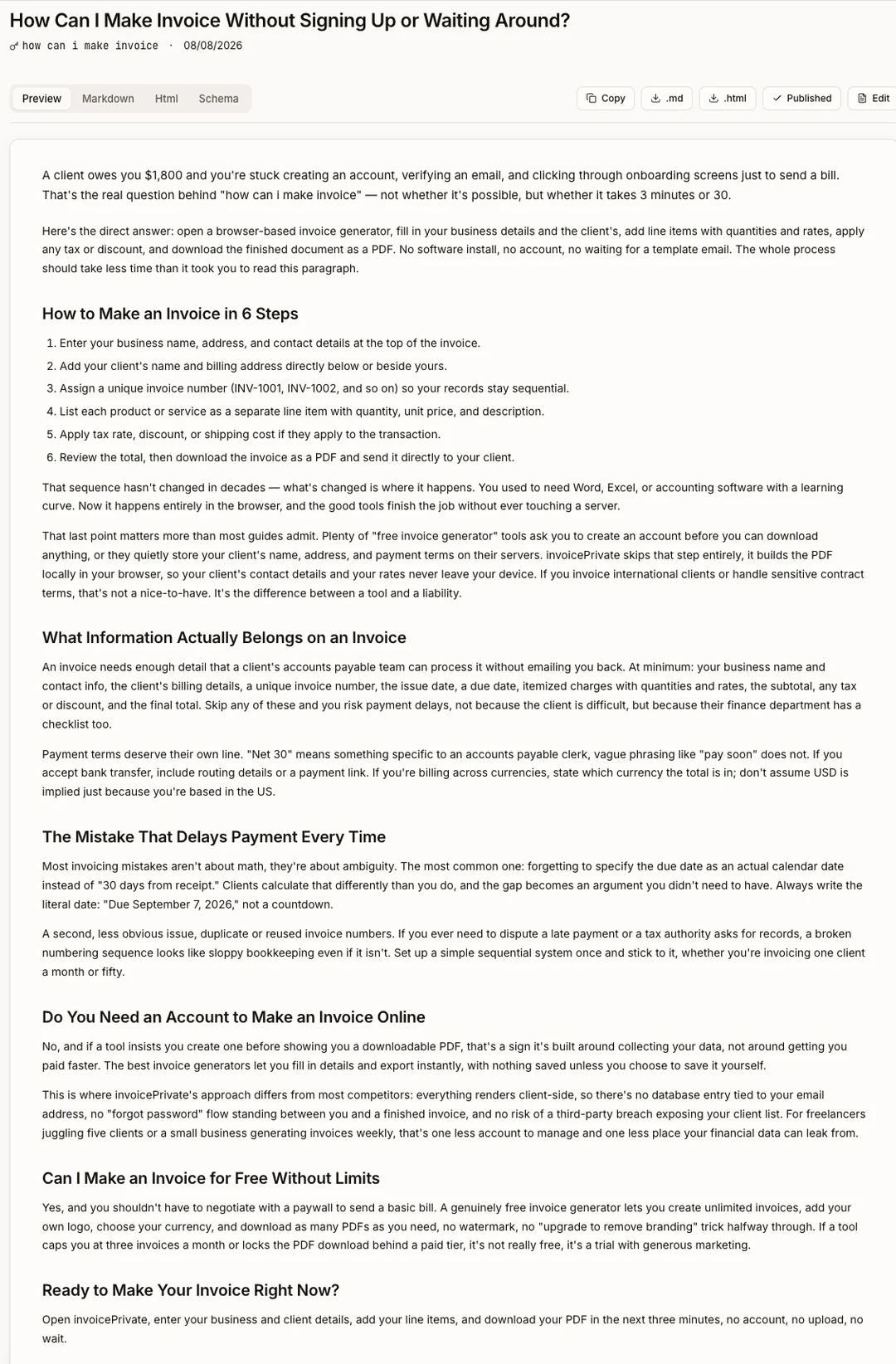
This is what "generate-then-finish" looks like in practice — a complete, structured starting point, still waiting on the edit pass that makes it yours.
What "fully automated publishing" gets wrong
The failure mode isn't AI — it's removing the human from the loop entirely. Generate-and-publish-unread treats content as a volume game. Google has spent years getting better at detecting exactly that, and the SERP-grounded AI writers that produce good drafts still produce drafts, not finished articles. The step you can never safely automate is the judgment: is this true, specific, and actually useful?
Do you have to disclose that you used AI?
Common worry, short answer: no. Google does not require you to label content as AI-assisted, and there's no ranking penalty or benefit tied to disclosure. Disclose if it fits your brand's transparency norms; skip it if not. Either way it's a trust-and-brand decision, not an SEO one.
The bottom line
Publishing AI-written articles is not a risk in itself. Publishing generic, unverified, unedited content at scale is, and it always was, AI or not. Use AI to skip the blank page, then do the part that makes content worth ranking: add your experience, check the facts, and make every vague sentence specific.
The founders who get burned by AI content aren't the ones using AI. They're the ones who mistook a draft for a finished article. Don't make that mistake, and AI is one of the best tools you have. For the fuller picture on how AI fits into search overall, see our take on GEO vs SEO.