E-E-A-T — Experience, Expertise, Authoritativeness, Trust — sounds like something only big brands with legal teams and author databases can win. It isn't. A solo founder has the one component that's hardest to fake and that AI can't manufacture: real, first-hand experience with the problem you're solving. The trick is showing it in ways Google's systems can actually read.
What E-E-A-T is (and isn't)
E-E-A-T is the framework from Google's Quality Rater Guidelines, the standard human raters use to assess whether content is high quality. The extra "E," Experience, was added to emphasize first-hand, lived knowledge.
Two clarifications that matter:
- It's not a direct ranking factor. There's no "E-E-A-T score" in the algorithm. It's a concept Google's ranking systems try to approximate through many signals. You optimize for the concept, not a metric.
- It's most important on "money and life" topics (health, finance) but applies everywhere. For SaaS, it's the difference between content that reads as authoritative and content that reads as anyone-could-have-written-this.
The reason it matters more now: as AI makes generic content infinitely cheap, the signals that prove real experience and expertise are what separate content that ranks from the flood that doesn't.
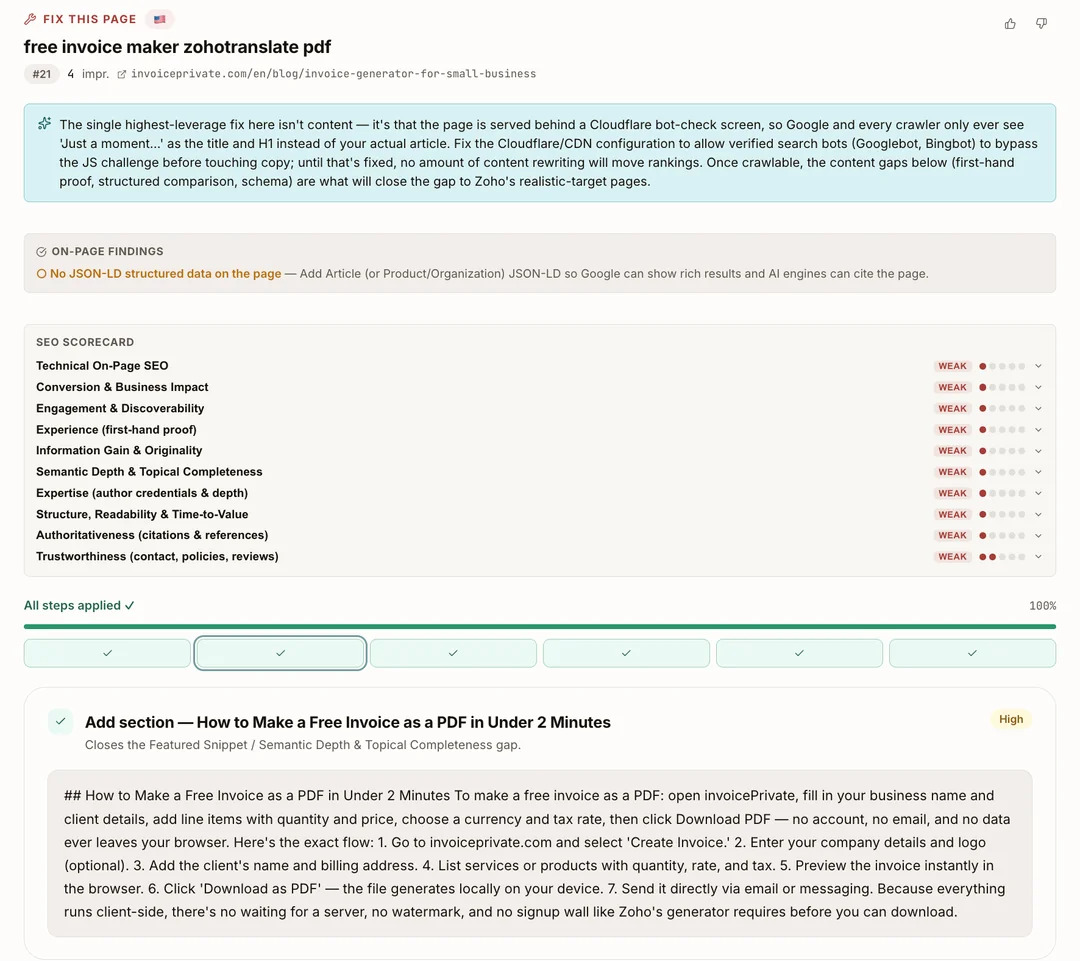
This is what it looks like when none of the four pillars are addressed — every one of them scores weak, on a page that's otherwise technically fine. Content quality signals, not technical SEO, are the gap.
The founder's advantage: Experience
This is where you win. Big content teams outsource articles to writers who've never used the product or lived the problem. You have. So show it:
- Write from what you've actually done. "When we switched our onboarding to X, activation went up 12%" beats "improving onboarding can increase activation." One is experience; the other is a guess anyone could type.
- Use real numbers from your own work. Your metrics, your experiments, your results. First-party data is the strongest experience signal there is, and no competitor or AI can copy it.
- Show the process, not just the conclusion. Screenshots, specific steps, the thing that went wrong and what you learned. Detail that could only come from having done it.
This is also why AI drafts need your edit pass, the model supplies structure; you supply the experience it structurally cannot have.
Expertise: make it visible
Expertise is knowing the subject deeply. You likely have it; the job is making it legible:
- Go deep, not wide. A page that thoroughly answers one question demonstrates more expertise than a shallow page touching ten. This is the case for topic clusters — depth across an interlinked set signals command of a subject.
- Be precise with terminology. Using the field's real vocabulary correctly is a quiet but strong expertise signal. Vagueness reads as not-really-knowing.
- Cover the nuances a novice would miss. The edge cases, the "it depends," the common mistake — these are what an expert includes and a generalist skips.
Authoritativeness: earn it off-page
Authority is others recognizing you as a source. It's the most external of the four, and it builds slowly:
- Get mentioned and linked by others in your space. Third-party recognition — mentions, citations, links from respected sites — is how authority accrues. It's also, not coincidentally, what makes AI engines cite you.
- Be consistent and present in the communities where your audience is. Authority compounds from showing up with useful answers over time.
- Build a real author identity. A named author with a genuine bio and a track record beats an anonymous "admin" or a faceless "Team" byline on every quality signal.
Trust: the foundation
Trust is the most important of the four, the others feed into it. For a SaaS site, the practical trust signals are unglamorous but real:
- Accuracy. Fact-check before you publish. One confidently wrong claim damages trust more than ten good paragraphs build it.
- Transparency. Clear about who you are, how to reach you, and any commercial stake. A visible about page, contact, and honest positioning all count.
- Site fundamentals. HTTPS, no deceptive patterns, clear navigation. Basic, but their absence is a trust red flag.
- Honest content. Say what a tool doesn't do, not just what it does. The willingness to state limits is itself a trust signal — it's why honest comparison pages outperform pure sales pitches.
The practical E-E-A-T checklist for a founder
You don't need an enterprise program. You need a few habits applied consistently:
- Add a real author bio with your name, role, and why you're credible on this topic.
- Put first-hand experience in every article — a real number, example, or lesson only you have.
- Fact-check before publishing, especially anything AI-assisted.
- Go deep on a few topics rather than shallow on many.
- Earn mentions by being genuinely useful in your community.
- Be transparent about who you are and what your product does and doesn't do.
The bottom line
E-E-A-T isn't an enterprise moat you can't cross. For a solo founder it's mostly the opposite — your lived experience is the hardest signal for anyone else to replicate, and it's exactly what a generic-content flood lacks. Show your work, use your real numbers, go deep, and be honest about limits. That's E-E-A-T, and it's the thing that makes your content — AI-assisted or not — read like it came from someone who actually knows.