"Move your page 2 keywords to page 1" is easy advice to give and easy to dismiss as too small to matter. So instead of asserting it works, this article looks at what the published data and documented case studies actually show about the size of that move, and what separates the wins from the wasted effort.
Every number below is sourced. None of it is ours.
The gap between page 1 and page 2 is enormous
The single most important fact about quick wins is how steep the click-through cliff is between the two pages.
Backlinko's analysis of 4 million Google search results found that only 0.63% of searchers click anything on page 2, while the #1 result earns an average CTR of 27.6% (Backlinko). Put differently: the first page of results captures the overwhelming majority of all clicks, and page 2 gets a rounding error's worth.
That's why a keyword sitting at position 12 is so frustrating. It's fully indexed, Google understands it, it's almost visible, and it's earning close to nothing, because it's on the wrong side of the cliff.
Even small position moves compound
You don't need to leap from page 2 to #1 to see a result. The same Backlinko dataset found that moving up a single position increases relative CTR by an average of 32.3%, and moving from #2 to #1 produces roughly 74.5% more clicks (Backlinko).
One caveat on these numbers: the CTR studies above were measured before AI Overviews became common on search results. Since then, click-through rates at the very top have compressed as the AI answer box absorbs some clicks. That doesn't weaken the case for quick wins — if anything it strengthens it, because the space above the traditional results is more crowded, so being stuck on page 2 is further from a click than these pre-2025 figures suggest. Read them as a conservative floor on the page-1-vs-page-2 gap, and see our take on what AI Overviews mean for SaaS SEO for the fuller picture.
So the math on a quick win is favorable at every step:
- Position 12 → position 8 crosses onto page 1, where clicks actually happen.
- Position 8 → position 4 roughly multiplies the clicks that page already earns.
- Position 4 → position 1 can more than double them again.
Each nudge is worth real traffic, and none of them requires a new article.
A documented on-page win
One published on-page case study is a clean illustration of how little it can take. The team shortened a title tag from 55 to 45 characters, moved the primary keyword to the front, and added a "2025" freshness modifier. The result was a 30% increase in click-through rate and a four-position ranking jump (ClickRank).
Nothing about that requires a rewrite or a link-building campaign. It's a title-tag edit — exactly the kind of fix that moves a page 2 keyword. The lesson isn't "always add '2025' to your titles." It's that the highest-weight on-page signals (the title and H1) are cheap to fix and disproportionately move rankings.
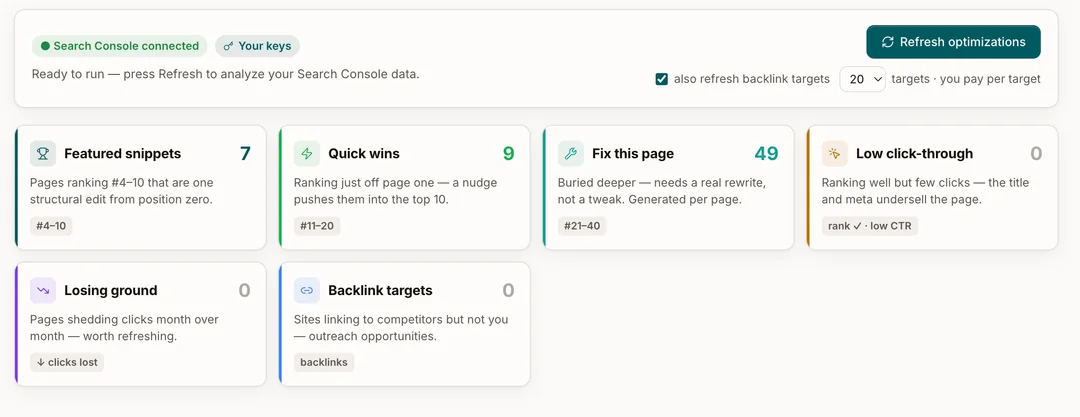
That's what the triage looks like on a real site: 7 near-miss snippets, 9 page-one-adjacent quick wins, and 49 buried pages that need more than a tweak — three different fixes, three different timelines.
Where the bigger, slower wins come from: clusters
Quick wins are the fast lever. The compounding lever is topic clusters — building a set of interlinked pages around one subject so Google treats your domain as authoritative on it. The published results here are larger but take longer to arrive:
- Minuttia documented a single well-built cluster ranking for 1,100+ keywords from one interlinked set of pages (Minuttia).
- A case study from thruuu tracked a cluster that grew organic traffic dramatically over months as the interlinked pages accumulated authority (thruuu).
The pattern across these: the results are real but they show up in months, not weeks, because they depend on multiple pages ranking and passing authority to each other.
The honest read: two timelines, two tactics
Put the data together and a clear strategy falls out:
For the next 30–60 days, chase quick wins. Pages already on page 2 are your best short-term investment because Google has already decided they nearly belong on page 1. The CTR data shows the payoff of moving them is large, and the ClickRank case shows the fixes can be trivial. This is where a solo founder should start — our guides to the on-page fixes and the technical fixes cover exactly how.
For the next 6–12 months, build clusters. The Minuttia and thruuu results are bigger, but they're a compounding investment, not a same-week payoff. Start them now so they mature while your quick wins deliver in the meantime.
What the case studies that fail have in common
The published wins share a trait, and so do the quiet failures. Quick-win attempts stall when the page being "optimized" was never really on page 2 to begin with — a keyword at position 40 isn't a quick win, it's a new-content problem in disguise. And cluster attempts fail when they're abandoned half-built: a hub with two spokes never triggers the topical-authority effect the case studies depend on.
The takeaway is unglamorous. The published data doesn't reward clever tricks. It rewards picking the pages that are genuinely close, making the specific fix, and finishing what you start.
Turning the data into a weekly habit
The reason quick wins get neglected isn't that founders doubt they work, the numbers above are widely known. It's that finding which pages are on page 2, this week, and which specific fix each one needs, is tedious to do by hand every week.
That's the job WriteGap automates: every Monday it pulls your Search Console data, surfaces the keywords sitting in positions 11–20 with real impressions, and tells you which page to fix and how. The published case studies show the payoff is there. The hard part is doing the check consistently, which is exactly the part worth automating.
Sources: Backlinko — Google CTR Stats, ClickRank — On-Page SEO Case Study, Minuttia — Topic Cluster Case Study, thruuu — Topic Clusters Case Study.